

Imagine pouring years of your life into a book. Staying up past midnight reworking scenes. Reading your own chapters so many times the words stop making sense. Finally closing your laptop on what feels like a finished manuscript — only to realize something is still off.
You can feel it but you can’t name it. The story is there. The characters are there. But somehow, the connection is not.
That was exactly where debut author Angela van Liempt found herself after finishing the first draft of her paranormal mystery, Wandering Souls. She had the story. She had the passion. What she was missing — and what she eventually discovered — was the one professional step that transforms a good manuscript into a book readers genuinely cannot put down.
That step was copyediting. And the results were staggering: 10,000 downloads in five days, a coveted BookBub featured deal, and a 4.5-star rating on Amazon.
Her story is not unique. It is, in fact, the story of almost every author who goes from “I wrote a book” to “I published a book people actually love.”
And it starts with understanding what professional editing truly does — and why it matters more than most first-time authors ever expect.
📖 Ready to transform your manuscript? Explore editing services at innovaciapublishers.com
The Invisible Problem Most Authors Cannot See in Their Own Writing
Here is the hard truth about writing your own book: you are too close to it.
After months of living inside your story, your brain fills in the gaps automatically. You know what your character is feeling, so you assume the reader does too. You know what the setting looks like, so you forget to describe it. You have read the same paragraph forty times, and what started as a clunky sentence now sounds completely normal to you.
This is not a failure of talent. It is simply the nature of how human memory and perception work. And it is precisely why professional copyediting exists.
Angela van Liempt discovered this when her copyeditor pointed out something that stopped her in her tracks. Her dialogue scenes, though well-written in isolation, had a critical flaw: they existed in a vacuum. Characters spoke, argued, and felt things — but the world around them had disappeared.
“When you write dialogue, you mostly write just dialogue. But people and their surroundings don’t stop existing when they speak to each other.”
That single observation — which Angela describes as perfectly pinpointing her issue — led to a cascade of improvements. Suddenly her arguments had weather. Her quiet moments had texture. Her characters had body language. The scenes that were technically correct became genuinely immersive.
This is what a skilled editor sees that you cannot see yourself. Not mistakes, necessarily. Opportunities. Places where your writing is good but could be extraordinary.
What Copyediting Actually Does (It Is Not What Most People Think)
Ask most people what a copyeditor does and they will say: fixes spelling and grammar. And while that is technically true, it is the smallest part of what a great copyeditor delivers.
Professional copyediting — particularly the kind that separates publishable books from forgettable ones — works on four deeper levels:
1. Grounding the Reader in Your World
Every scene needs an anchor. Where are we? What does it feel, smell, sound like? When your prose loses that grounding — even briefly — readers disengage. A copyeditor catches the moments where your writing has drifted into what is called “white room syndrome”: technically complete sentences that exist in no particular place or time.
Angela’s editor helped her flesh out exactly these moments — using setting, sensory detail, and atmosphere not as decoration, but as active tools for storytelling.
2. Sharpening Your Character’s Inner Voice
Internal monologue is one of the most powerful tools a fiction writer has. When done well, it creates an intimacy between reader and character that is unlike anything else in literature. When done poorly — with repetitive phrasing, monotonous rhythm, or excessive questioning — it pulls the reader out of the story.
Angela found that she had been leaning heavily on a string of questions to convey her protagonist’s emotional state. The effect was unintentional urgency and distance, not intimacy. Her editor helped her convert those questions into statements, varying rhythm to match mood, bringing the reader closer to the character rather than keeping them at arm’s length.
3. Pacing and Rhythm
Great prose has a rhythm. Short sentences create tension. Longer, flowing sentences slow things down, inviting the reader to breathe and feel. A copyeditor listens to the music of your writing and flags where the tempo is off — where a chase scene plods, or where a tender moment rushes past too quickly.
4. Consistency and Clarity
Characters whose eye color changes between chapters. A timeline that does not quite add up. A technical term used three different ways. These are the details that break reader trust — not dramatically, but quietly, cumulatively. A thorough copyeditor catches every one of them.
✍️ Every author deserves an editor who sees what they cannot. Connect with Innovacia Publishers today.
Why the “I Will Edit It Myself” Approach Costs Authors More Than They Realize
We know what you are thinking. You have been a voracious reader your entire life. You have a good eye. You caught a typo in a restaurant menu last Tuesday. How different can editing your own book really be?
Very different. Here is why.
Self-editing is limited not by skill but by familiarity. You cannot un-know your own story. When you read your manuscript, your brain is not reading the words on the page — it is reading the words you intended to write. The gap between those two things is where errors, inconsistencies, and missed opportunities live.
More importantly, self-editing cannot give you what a professional editor gives you: a reader’s perspective. Not a critique partner’s perspective, or a friend’s “it was really good!”, but the calibrated, experienced eye of someone who has helped dozens of authors bridge the gap between a good story and a great book.
The authors who skip this step often spend more in the long run — through negative reviews, relaunches, and the slow, painful realization that a book they worked years on is not performing the way it should.
Angela’s results tell a different story. Professional editing did not just improve her book. It gave her the confidence to submit to BookBub. It translated 10,000 free downloads into a wall of five-star reviews. It built the foundation for a series.
The Innovacia Publishers Approach: Editing That Serves Your Vision
At Innovacia Publishers, we believe that editing is not about changing your voice. It is about amplifying it.
Every author comes to us with something genuine — a story worth telling, a perspective worth sharing, an idea that deserves to reach its audience. Our role is to make sure nothing stands between that story and the reader who needs to find it.
Our editing services are built around four principles:
- Your voice stays yours — we enhance what is already working, never replace it with ours
- Collaboration at every stage — you are part of the process, not handed a finished document and told to accept it
- Reader-first thinking — every suggestion we make is in service of the reader experience
- Revisions until you are satisfied — because a book is not done until you feel it is right
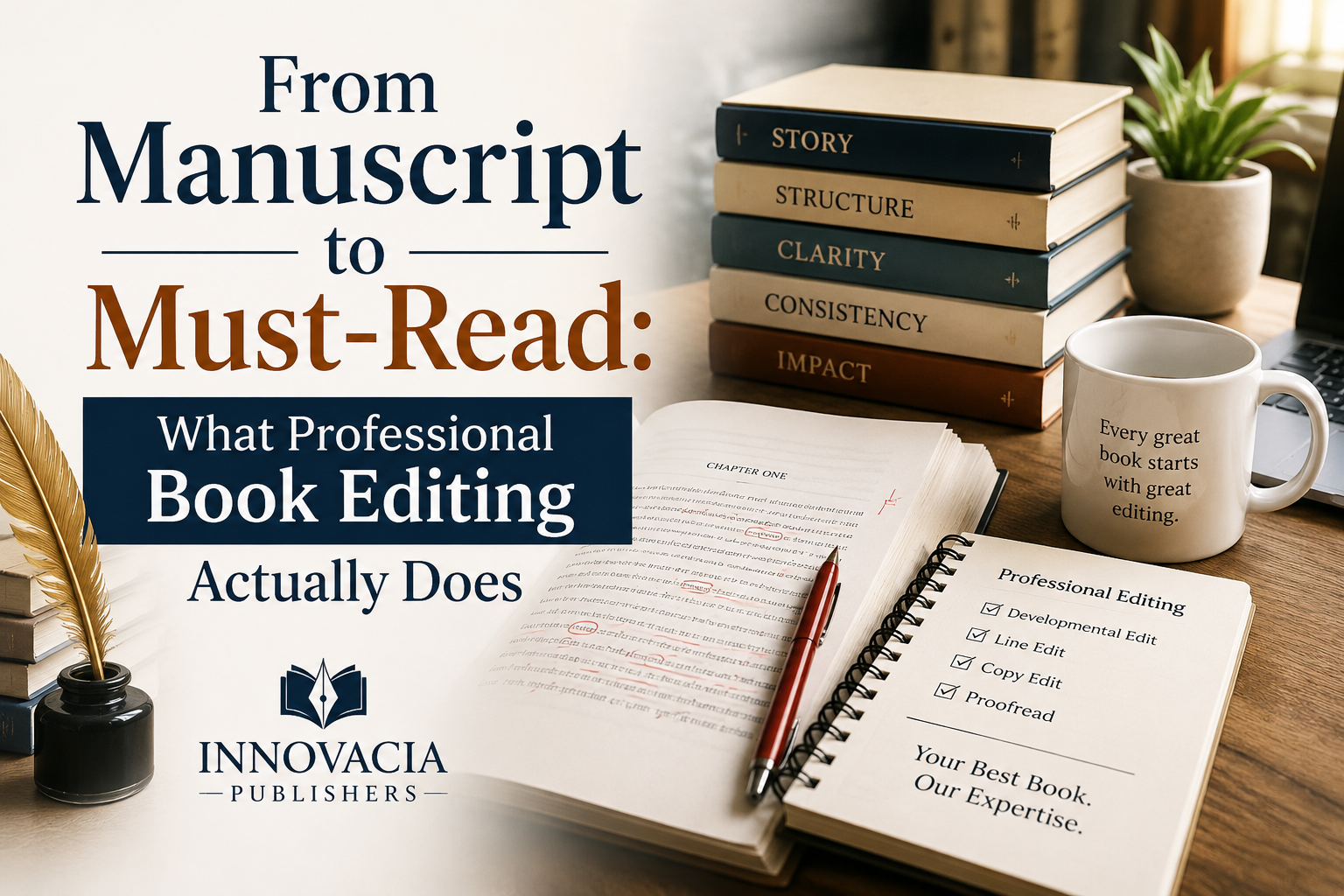
Whether you need a full developmental edit, a line edit, copyediting, or proofreading — or a combination of all four — we have experienced editors who specialize in your genre and understand your audience.
We have helped authors turn hesitant first drafts into published books. We have helped businesses transform expertise into readable, professional non-fiction. We have helped creators take an idea from a rough outline to a polished, published work ready for Amazon, Kobo, Barnes & Noble, and IngramSpark.
“Good writing is a central pillar for building that connection with the reader — and much more than just a vessel for a story.”
That is the heart of it. A well-edited book does not just communicate information or tell a story. It creates a relationship between writer and reader. And that relationship is what keeps readers coming back — for the sequel, for the next title, for everything you write next.
What to Look for When Hiring a Book Editor
Not all editing services are equal. Here is what genuinely matters when you are choosing who to trust with your manuscript:
Genre experience
A great literary fiction editor may not be the right fit for your paranormal thriller. Look for editors who have worked extensively in your genre and understand its conventions, reader expectations, and market.
Sample edits
Any professional editor worth hiring will offer a sample edit of the first few pages before you commit. This tells you more about their style and fit than any bio or list of credentials.
Clear communication
Your editor should explain why they are suggesting a change, not just mark it. The best editors are teachers as much as they are technicians — you should come out of the process a better writer, not just with a better book.
Transparency on scope
Understand upfront what type of editing you are getting. Developmental editing addresses structure and story. Line editing focuses on prose style and language. Copyediting handles consistency, mechanics, and clarity. Proofreading catches final errors before publication. These are different services with different outcomes.
Honest feedback
You do not want an editor who tells you everything is perfect. You want one who respects your work enough to tell you the truth — delivered with care, but delivered clearly.
🚀 Start your publishing journey at innovaciapublishers.com — Let’s build something worth reading.
Your Story Deserves to Be Read the Way You Imagined It
Angela van Liempt’s debut novel reached 10,000 readers in five days. Those readers left reviews raving about the atmosphere, the characters, the immersive world she had built. They came for a paranormal mystery and found something that stayed with them.
None of that happens without the editing process. Not because her writing was broken, but because great editing is what closes the gap between the story in your head and the story on the page.
You have something worth saying. You have put in the work to say it. Now give it the professional attention it deserves — so when it finally reaches your readers, it lands exactly the way you always imagined it would.
Innovacia Publishers is ready when you are.
📩 Get in touch today: innovaciapublishers.com | Info@innovaciapublishers.com
Frequently Asked Questions
What is the difference between copyediting and proofreading?
Copyediting addresses consistency, mechanics, clarity, and style — it is a deeper review of how your prose is working. Proofreading is the final pass for typos and formatting errors before the book goes to print or upload. Both are essential, and they happen at different stages of the process.
How do I know if my manuscript needs a developmental edit or a copyedit?
If you are unsure about your story’s structure, pacing, or character arcs, start with a developmental edit. If your story feels solid but your prose needs refinement and consistency, copyediting is the right next step. Many authors benefit from both — in sequence.
Will editing change my writing voice?
A professional editor enhances your voice, they do not replace it. The goal is always to make your writing sound more fully like you — clearer, more consistent, and more effective at creating the experience you intend for your reader.
How long does professional book editing take?
Timelines vary depending on manuscript length and the type of edit required. A copyedit of a standard-length novel typically takes 2–4 weeks. Discuss timelines with your editor upfront, particularly if you have a launch date in mind.