

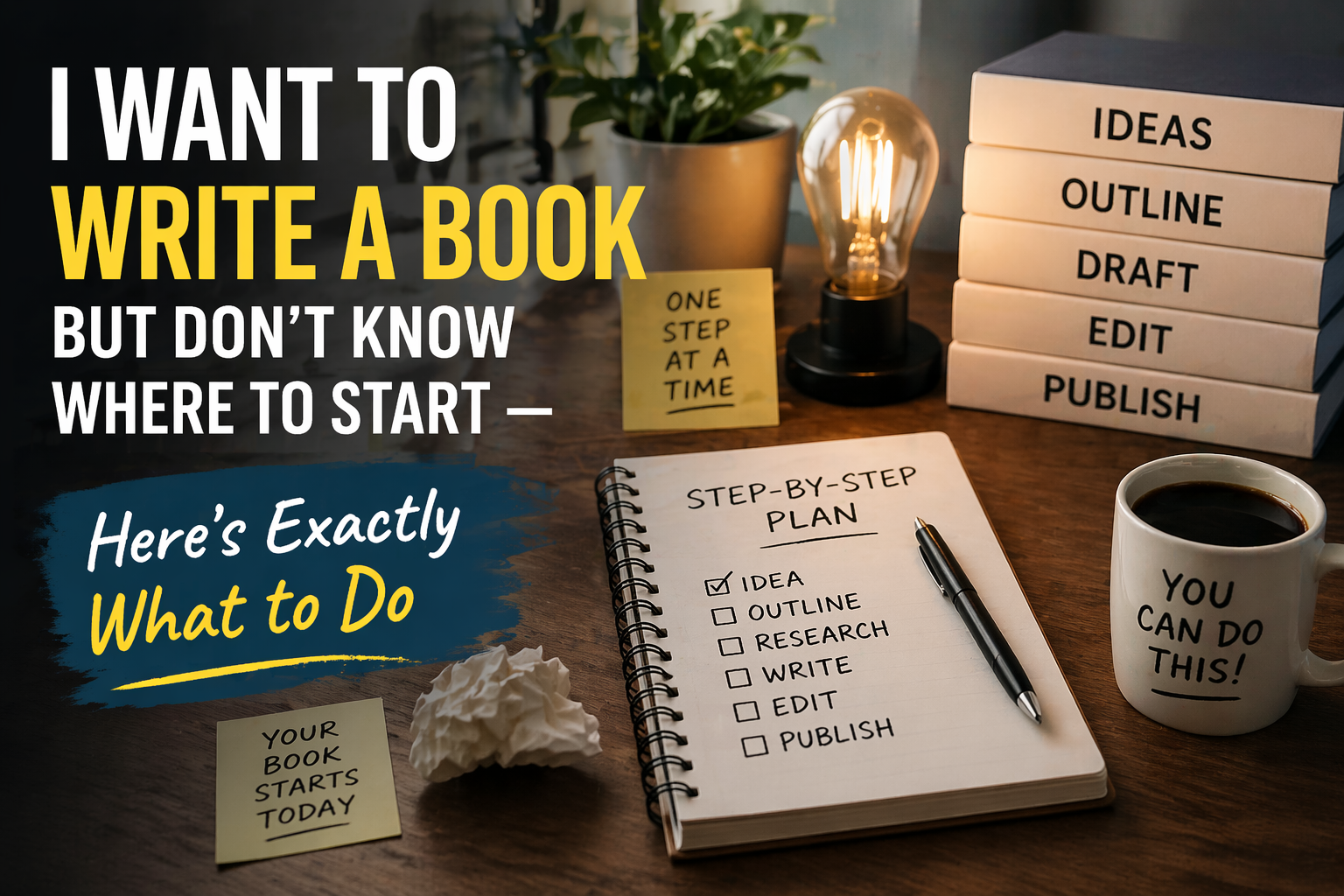
The complete, honest guide for first-time authors in 2026 — from idea to published book, without the confusion.
You have a story inside you. Or a business lesson no one else has written. Or a life experience that could change someone else’s. Maybe you’ve had the idea for years. You’ve mentioned it to friends. You’ve even typed out a few pages. But every time you try to move forward, you hit the same wall: where do I actually begin?
You’re not alone. Every single day, thousands of people search variations of “I want to write a book” — and most of them never get past that sentence. Not because they lack the idea. Not because they lack the story. But because no one ever showed them the full map.
This is that map.
Whether you plan to write the book yourself, hire a ghostwriter, or use a publishing service to handle the heavy lifting — this guide walks you through every decision, every cost, every timeline, and every option available to you right now in 2026. No fluff. No upsell disguised as advice. Just the real picture.
— STEP ONE —
Start Here: Get Brutally Clear on What Kind of Book You Actually Want to Write
Before you hire anyone, buy any software, or write a single sentence — you need to answer four questions. These questions seem simple. They are not. Most aspiring authors skip them and spend months going in the wrong direction.
Question 1: What is the ONE thing your book is about?
Not the genre. Not the tone. The one central idea, story, or argument. If you can’t say it in two sentences, you’re not ready to write — you’re still thinking. And that’s okay. Spend a week on this question before you do anything else.
✏️ Try this: Complete this sentence — ‘My book is for [who] and it will help them [do what] by showing them [what].’ If you can’t fill in those blanks, your idea still needs shaping.
Question 2: Who is your reader — and why will they care?
This is not a question about demographics. It’s a question about pain, desire, or curiosity. Your reader is either trying to solve a problem, understand something, escape somewhere, or feel less alone. Which one is it? The clearer your answer, the better your book will perform — whether you sell it on Amazon, use it to grow a business, or give it away as a lead magnet.
Question 3: What format and length makes sense?
A 300-page memoir is a very different project from a 80-page business book or a 15,000-word eBook. Each has its own market, price point, timeline, and publishing path. Here’s a rough guide:
- Great for lead generation, digital products, or testing an idea. Can be written in 4–8 weeks. Low cost to produce. Short eBook (10,000–20,000 words):
- The most commonly hired ghostwriting project. Establishes authority. 3–6 months to write and publish professionally. Business / Self-Help book (30,000–60,000 words):
- Requires the most skill. Emotionally demanding. 6–12 months with a professional team. Memoir / Narrative Nonfiction (60,000–90,000 words):
- Longest timeline. Requires the most creative investment, with or without help. Fiction / Novel (70,000–100,000+ words):
Question 4: What is this book supposed to do for you?
This is the question most people never ask out loud. But the answer shapes every decision afterward. A book written to grow your consulting business is structured and marketed completely differently from a book written to heal after personal loss. Know your purpose before you spend a dollar or a day on it.
— STEP TWO —
Your Three Paths: Writing It Yourself, Hiring a Ghostwriter, or Using a Full Publishing Service
Once you know what you’re writing, you face the most important decision of the entire process. How is this book actually going to get written?
In 2026, you have three realistic paths. Each has a completely different cost, timeline, and quality ceiling. Here is an honest breakdown of all three.
Path A: Write It Yourself
This is the most romantic option. It’s also the one that produces the most unfinished manuscripts sitting in Google Docs.
Writing a book yourself takes discipline that most people underestimate. The average nonfiction book takes 300–500 hours to research, draft, and revise. That’s roughly 6–18 months of consistent work for someone who isn’t a professional writer.
It works best when you have:
- Strong writing skills and prior experience
- A flexible schedule and long stretches of uninterrupted time
- The ability to self-edit ruthlessly — or the budget to hire an editor at the end
- A subject you know so deeply that research is minimal
If you choose this path, invest in a good developmental editor when you finish. A professional edit on a self-written book typically costs $1,000–$5,000 and is the single best money you can spend.
⚠️ Reality check: Over 97% of people who start writing a book on their own never finish it. That’s not a judgment — it’s a structural problem. The process has no accountability, no deadlines, and no one to push back when you get stuck.
Path B: Hire a Ghostwriter
A ghostwriter is a professional writer who writes your book for you — using your ideas, your stories, your voice — and gives you 100% ownership of the final product. Your name goes on the cover. Always.
Ghostwriting is completely legal, widely practiced, and far more common than most people realize. Many of the bestselling books you’ve read — memoirs, business titles, self-help books, celebrity autobiographies — were written in whole or in part by ghostwriters. This is an open industry secret.
What does a ghostwriter actually do? They typically:
- Conduct a series of in-depth interviews with you over several weeks
- Research your subject matter thoroughly
- Write in your voice — matching your tone, phrasing, and perspective
- Deliver chapter-by-chapter drafts for your review and feedback
- Revise based on your input until the book sounds exactly like you
- Sign an NDA (Non-Disclosure Agreement) so full confidentiality is maintained
How much does a ghostwriter cost in 2026?
This is the number-one question people search before hiring a ghostwriting service. Here’s the real breakdown based on current market rates:
Short eBook (under 20,000 words): $1,500 – $5,000 — entry-level ghostwriter
Business book (30,000–50,000 words): $8,000 – $30,000 — mid-level professional
Full memoir or narrative nonfiction: $20,000 – $75,000 — experienced specialist
Celebrity / high-profile book: $100,000 – $1,000,000+ — elite ghostwriter
Book proposal only (for traditional publishing): $2,000 – $7,000 — includes sample chapter
Prices vary widely because ghostwriting is not a commodity. A writer with 20 published books who understands your industry will charge more than someone fresh to the field — and will produce a dramatically different result.
💡 Pro tip: If someone quotes you a completed 60,000-word book for $1,500 or less, that’s a serious red flag. At that price point, you are almost certainly getting AI-generated content with light editing — not a professionally crafted manuscript written in your voice.
Path C: Use a Full-Service Book Publishing Company
This is the option most people don’t know exists — and it’s often the smartest choice for first-time authors who want a complete, professional book without managing ten different vendors.
A full-service publisher handles everything under one roof:
- Ghostwriting or manuscript development
- Professional editing (developmental, line editing, proofreading)
- Book cover design
- Formatting for print and digital
- eBook publishing across platforms (Amazon KDP, Barnes & Noble, Kobo, Scribd, Apple Books)
- Book marketing and launch strategy
- Optional: audiobook production, author website, video trailer
The advantage is total simplicity. You share your ideas. You review drafts. You approve the final product. The team handles everything else.
The disadvantage is cost — full-service packages typically range from $3,000 to $25,000+ depending on the scope. But when you factor in the alternative — hiring a ghostwriter, then an editor, then a designer, then a formatter, then a marketer separately — the bundled approach often saves both money and months of coordination.
— STEP THREE —
Self-Publishing vs. Traditional Publishing: Which Path Is Right for You in 2026?
After your manuscript is written, you face another major decision: how do you get this book into the world?
In 2026, the publishing landscape looks very different from even five years ago. Traditional publishing is no longer the default. Self-publishing is no longer the backup plan. Here’s an honest comparison:
Traditional Publishing
Traditional publishing means a major publishing house (like Penguin Random House, HarperCollins, or Simon & Schuster) acquires your book, funds its production, and distributes it through major retail channels.
What it requires:
- A completed manuscript or strong book proposal
- A literary agent (most major publishers won’t accept unsolicited submissions)
- An average wait time of 1–3 years from submission to bookstore shelves
- Willingness to give up significant creative control and a large share of royalties (typically 10–15% for new authors)
The upside: prestige, editorial support, physical bookstore placement, and zero upfront cost. The downside: extremely selective, incredibly slow, and you have almost no say in your cover, title, or marketing strategy.
📊 Reality: Less than 1% of submitted manuscripts are accepted by major traditional publishers. For most first-time authors, this is not a realistic short-term path.
Self-Publishing
Self-publishing means you own everything: the manuscript, the cover, the pricing, the royalties, and the marketing. You publish directly through platforms like Amazon KDP, IngramSpark, Barnes & Noble Press, and others.
What you keep: 35–70% royalties depending on the platform and pricing. Full creative control. Fast timeline — a professionally produced self-published book can go from manuscript to live in 4–8 weeks.
What you’re responsible for: All costs upfront. All marketing. All quality control. A poorly produced self-published book fails not because self-publishing is bad — but because the author skipped professional editing, cover design, or formatting.
In 2026, self-publishing is the dominant path for new authors, business books, memoirs, and niche nonfiction. Many traditionally published authors are now choosing self-publishing for subsequent books because the economics are simply better.
Hybrid Publishing
Hybrid publishers sit between traditional and self-publishing. They offer professional editing, design, distribution, and marketing support — but the author typically pays some or all of those costs upfront. In return, the author keeps a much higher royalty (40–70% vs. 10–15% with traditional publishing).
This is where companies like Innovacia Publishers operate — and for the right author, it’s the sweet spot between quality, speed, and creative control.
— STEP FOUR —
The Real Timeline: How Long Does It Actually Take to Write and Publish a Book?
One of the biggest frustrations for aspiring authors is the complete lack of honest timelines. Here’s a realistic, unfiltered breakdown:
If you write it yourself:
- First draft: 3–12 months (depending on your writing pace and schedule)
- Revision and self-editing: 1–3 months
- Professional editing: 4–8 weeks
- Cover design and formatting: 2–4 weeks
- Publishing setup and launch: 2–4 weeks
Total: 6 months minimum, 18+ months realistically for most first-time authors.
If you hire a ghostwriter or use a full-service publisher:
- Discovery and outlining phase: 2–4 weeks
- Interview / research phase: 2–6 weeks
- Drafting (chapter by chapter): 8–20 weeks
- Revisions based on your feedback: 4–8 weeks
- Editing, design, and formatting: 4–8 weeks
- Publishing and launch: 2–4 weeks
Total: 5–9 months for a professionally produced book, start to finish.
📅 Important: Anyone promising a full, high-quality manuscript in 2–3 weeks is either using AI to generate bulk content or cutting corners that will show in the final product. Quality books take time — and that’s actually a good sign.
— STEP FIVE —
The AI Question: Can’t I Just Use ChatGPT to Write My Book?
This is the question on everyone’s mind in 2026. And it deserves a straight answer.
Yes, AI tools can help you brainstorm, outline, research, and draft sections of content quickly. Many professional writers — including ghostwriters — use AI for specific tasks like transcribing interviews, generating first-draft chapter summaries, or brainstorming section structures. That’s entirely legitimate.
But using AI to write your entire book — and publishing it as your own — comes with serious, underreported problems:
- The Library of Congress will not register AI-authored works. This means your book — including its content and cover — may be in the public domain with no legal recourse if someone copies it. AI-generated books cannot receive copyright protection.
- Amazon KDP and major distributors are tightening policies on AI books. A wave of AI-generated titles is already flooding the marketplace and eroding reader trust. Many publishers and platforms are banning AI-generated content.
- Even the most advanced AI tools produce writing that lacks emotional depth, authentic voice, and the lived experience that makes a book genuinely worth reading. Industry insiders in 2025 described AI content as ‘bland, clichéd, and forgettable.’ That reputation is spreading to readers. AI writing is detectable, and readers can feel it.
- If you’re using a book to establish thought leadership, consulting authority, or personal brand — a book that reads like a chatbot wrote it does more damage than no book at all. It risks your professional reputation.
The smart approach in 2026: Use AI as a tool within a human-led writing process. Use it to organize notes, brainstorm chapter titles, or transcribe voice memos. But the actual voice, the real stories, the emotional resonance — that has to come from a human. Preferably you, or a skilled ghostwriter working closely with you.
— STEP SIX —
What to Look for When Hiring a Book Writing or Publishing Company
If you decide to work with a ghostwriting or publishing service, the quality of who you hire matters enormously. Here are the questions every aspiring author should ask before signing a contract:
- Some companies accept your project and hand it to a freelancer you’ve never spoken to. Ask specifically: who is the writer, what have they written before, and can you speak with them before committing? Who actually writes my book?
- Non-negotiable. The copyright to your book must be entirely yours from the moment you sign the contract. Request this in writing. Do I own 100% of the copyright?
- A professional ghostwriting or publishing service will always offer an NDA. If they don’t, ask for one. If they refuse, walk away. Is there a confidentiality agreement?
- You should receive drafts chapter by chapter and be able to request revisions before the team moves forward. Avoid any service that delivers the entire manuscript at the end with limited revision rounds. What does the revision process look like?
- Editing, cover design, formatting, and publishing setup are all separate services. Make sure you know exactly what’s included before you compare prices between companies. What is included in the package?
- A reputable publisher or ghostwriting company will have a portfolio of completed books. Ask for samples in your genre or subject area. Can I see samples of their work?
- This is the most important question. A ghostwriter who doesn’t conduct extensive interviews with you before writing cannot write in your voice. Period. What is their process for capturing my voice?
— QUICK ANSWERS —
The Most Googled Questions About Book Writing and Publishing — Answered
Q: Is ghostwriting cheating?
A: No. Ghostwriting is legal, ethical, and has been standard practice in publishing for centuries. Presidents, CEOs, celebrities, and bestselling authors have all worked with ghostwriters. The idea in your head is yours. The published book is yours. A ghostwriter is a skilled professional who helps you execute it.
Q: Do ghostwriters keep my information confidential?
A: Yes — professional ghostwriters and publishers sign an NDA (Non-Disclosure Agreement). This legally binds them to confidentiality. They cannot claim credit for your book, cannot share your content, and cannot discuss your project publicly without your permission.
Q: How much does it cost to publish a book in 2026?
A: Publishing alone (without writing) costs $500–$5,000 for professional editing, cover design, formatting, and distribution setup. If ghostwriting is included, the total investment ranges from $3,000 for a short eBook to $30,000+ for a full-length professionally ghostwritten book.
Q: How long does a ghostwriter take to write a book?
A: A professional ghostwriter typically takes 4–9 months to write a full-length book, depending on the length, research required, and your availability for interviews and feedback. Rushed timelines almost always produce weaker books.
Q: Can I publish my book on Amazon?
A: Yes. Amazon KDP (Kindle Direct Publishing) is the most widely used self-publishing platform in the world. A professional publishing service will handle all the technical setup — file formatting, BISAC categories, metadata, pricing — and can list your book on Amazon, Barnes & Noble, Kobo, Apple Books, and more simultaneously.
Q: Do I need a literary agent?
A: Only if you’re pursuing traditional publishing with major publishers. For self-publishing and hybrid publishing — which covers the vast majority of new authors today — you do not need an agent. A full-service publishing company handles what an agent would otherwise manage.
Q: What’s the difference between an eBook and a print book?
A: An eBook is a digital file (usually EPUB or MOBI format) sold on platforms like Amazon Kindle, Apple Books, and Kobo. A print book is a physical paperback or hardcover. Most authors publish both simultaneously. Print-on-demand technology means you don’t need to order inventory — physical copies are printed and shipped individually as orders come in.
Q: Will my book actually make money?
A: That depends entirely on your marketing, your niche, your platform, and your goals. Most first-time authors earn modest royalties from book sales alone. The bigger ROI often comes from what the book enables — speaking engagements, consulting clients, course sales, media features, and brand authority. A book is a long-term asset, not a lottery ticket.
The Bottom Line: Your Book Is Closer Than You Think
The single biggest reason most people never write their book is not a lack of talent, time, or story. It’s the paralysis of not knowing where to begin — and the fear of doing it wrong.
But here’s what the most successful first-time authors all have in common: they stopped waiting to feel ready, and they found the right support system. Some wrote it themselves with professional editing. Some hired a ghostwriter who captured their voice perfectly. Some handed it to a full-service team and showed up for interviews and approvals.
All of them ended up with a book. None of them regretted it.
The idea in your head has a deadline — not a publisher’s deadline, but the natural one that life sets for all of us. The longer it waits, the heavier it gets. The best time to start was last year. The second best time is today.
Ready to Turn Your Idea Into a Published Book?
At Innovacia Publishers, we help authors, entrepreneurs, thought leaders, and first-time writers go from idea to published book — with professional ghostwriting, expert editing, stunning cover design, full publishing setup, and book marketing under one roof.
We’ve helped writers across every genre: memoirs, business books, self-help titles, children’s books, eBooks, fiction, and more. Our process is collaborative, transparent, and built around capturing your voice — not ours.
Get started today: Visit innovaciapublishers.com or call us at (307) 218-7851 (USA) | (647) 692-0203 (Canada)
Email: Info@innovaciapublishers.com | Available 7 days a week