

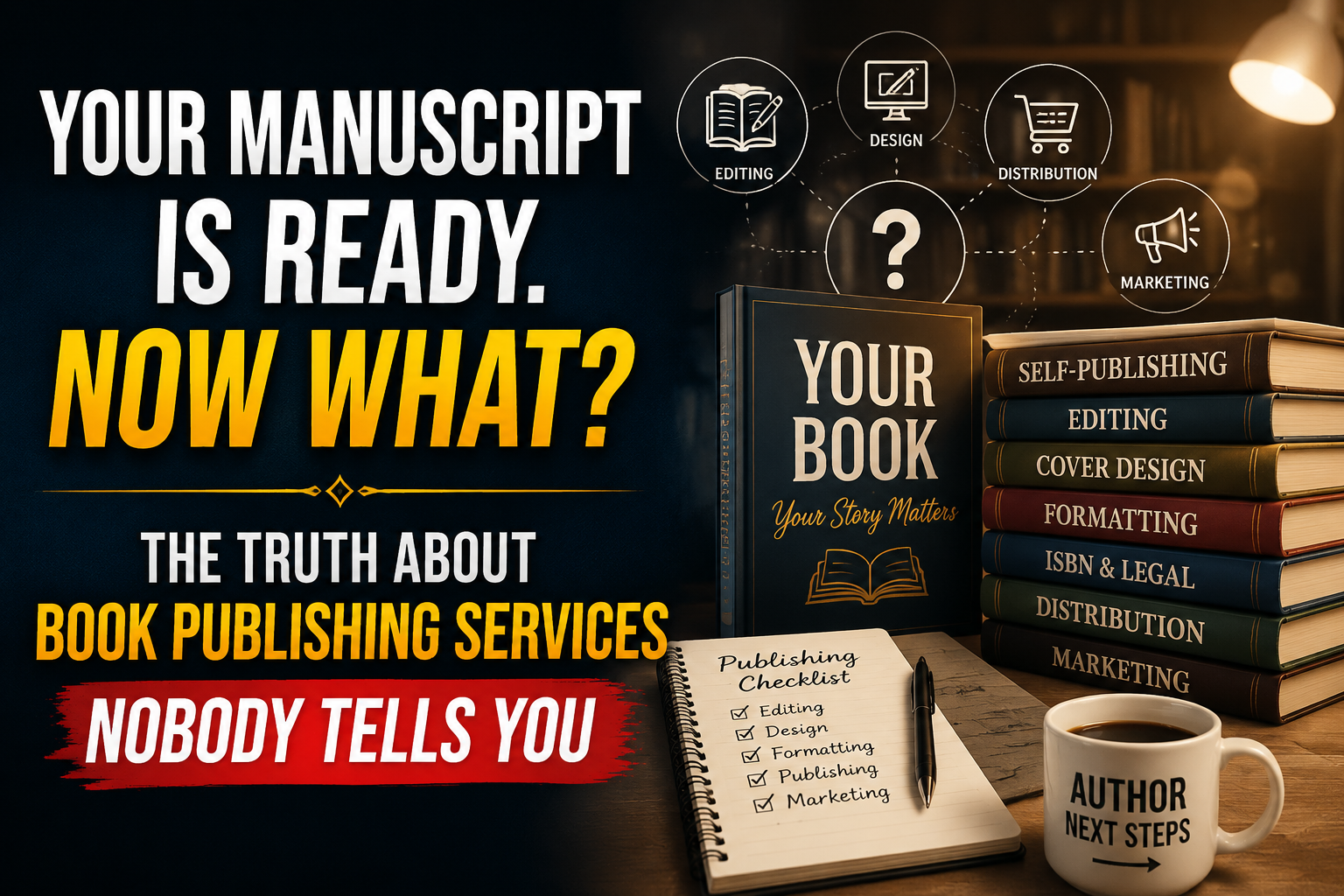
A straight-talking guide for aspiring authors, entrepreneurs, and experts who are done waiting.
You have a book inside you. Maybe it’s a memoir, a business guide, or a novel you’ve been nursing for three years. You’ve finally decided to do something about it — and now you’re drowning in options. Self-publish? Traditional publisher? Hybrid? Ghost writer? The publishing world is not short on choices, but it is very short on straight answers.
That’s exactly why this post exists. After 15 years working inside the book publishing ecosystem — from developmental editing to distribution deals — I want to give you the map most people never get. Book publishing services have exploded in the last decade, and not all of them deserve your money or your trust.
Let’s cut through the noise.
What “Book Publishing Services” Actually Means in 2026
Most people Google “book publishing services” and expect one thing. What they find is three completely different industries wearing the same label.
There are traditional publishing houses (think Penguin Random House), self-publishing platforms (Amazon KDP, IngramSpark), and hybrid or assisted publishing companies that charge you fees in exchange for professional services. Each has a completely different value proposition, timeline, and risk profile.
Here’s the honest breakdown:
- Traditional Publishing: They pay you an advance. They own most decisions. Expect 12–24 months from acceptance to bookshelf — if you get accepted at all. Less than 1% of query letters result in a deal.
- Self-Publishing Platforms: You keep all rights and most royalties. You also do all the work — or hire people to do it. Fast to market, low overhead, but your cover design and editing quality are 100% on you.
- Hybrid / Assisted Publishing: You pay for professional services (editing, design, distribution) but retain your rights. This is the fastest-growing segment — and the one with the most predatory operators.
The Ghost Writing Factor: Why More Authors Are Outsourcing the Words
Here’s something the publishing industry doesn’t advertise: a huge percentage of nonfiction books, especially by business leaders and public figures, are ghost written. This is not cheating. It’s smart.
You have the ideas, the expertise, the story. A professional ghostwriter has the craft to shape it into something people actually finish reading. The two things are not the same skill, and pretending they are costs authors years of frustration.
What a Ghostwriter Actually Does for You
A good ghostwriter doesn’t just “write your book.” They interview you extensively, capture your voice, structure your ideas for maximum impact, and deliver a manuscript that sounds unmistakably like you — only cleaner, tighter, and more readable.
What to expect when hiring a ghostwriter:
- Multiple deep-dive interviews to extract your story and ideas
- A structured outline you approve before a single chapter is written
- Drafts, revisions, and feedback rounds built into the timeline
- Full confidentiality — the book publishes under your name, full stop
The Ebook Opportunity Most Authors Completely Ignore
Stop thinking of ebooks as the “cheap version” of a real book. That mindset is costing you revenue and reach.
Ebooks now represent a significant slice of the global publishing market, and for nonfiction, business, and self-help categories, they frequently outsell print. The margins are better, the distribution is instant, and you can update your content without reprinting 2,000 copies.
Professional ebook writing services will format your manuscript for Kindle, Apple Books, and Kobo simultaneously, handle metadata and categories (which directly affect discoverability), and set up your backend pricing strategy. This is not something you want to fumble through manually.
The Lead Magnet Angle Nobody Talks About
If you run a business, a shorter ebook — 20 to 60 pages — functions as one of the most powerful lead magnets in existence. It builds authority, grows your email list, and starts relationships with potential clients before you ever speak to them.
A well-written short ebook converts better than almost any ad campaign at a fraction of the cost.
How to Evaluate a Book Publishing Service Without Getting Burned
The assisted and hybrid publishing space has real operators and real predators. Here’s how to tell them apart before you sign anything.
Green Flags Worth Paying For
- They show you samples. Not testimonials. Actual published books they produced.
- You retain your rights. Non-negotiable. Any contract that assigns copyright to the publisher is a red flag.
- Clear deliverables and timelines. Vague contracts produce vague results.
- Separate, named professionals. Your editor, designer, and formatter should be identifiable people, not “our team.”
Red Flags That Should End the Conversation
- They guarantee bestseller status (Amazon gaming is real, but manufactured lists are worthless)
- Pricing is buried or only revealed after a sales call
- No physical address or verifiable business history
- They pressure you to decide within 24–48 hours
Book Publishing Services That Actually Build Your Brand
The smartest authors today treat their book as one piece of a larger content ecosystem. Your book drives speaking gigs, consulting inquiries, media appearances, and premium product sales. But only if it’s positioned correctly from day one.
This is where the right publishing partner earns their fee. They’re not just formatting your manuscript. They’re thinking about your title’s searchability on Amazon, your cover’s performance as a thumbnail, your back matter’s ability to drive email signups, and your category placement for maximum discoverability.
The book is the product. The brand is the business. A serious publishing service understands both.
What to Do Right Now (Not Next Quarter)
Stop researching and start moving. Here are three concrete next steps depending on where you are:
- You have an idea but no manuscript: Get on a call with a ghostwriter. Most offer free consultations. Bring a one-page concept summary and three reasons you’re the right person to write this book.
- You have a draft: Hire a developmental editor before you touch formatting or covers. Structure problems can’t be fixed with a copyedit.
- You have a finished manuscript: Stop sitting on it. Get three quotes from hybrid publishers or self-publishing service providers and compare deliverables, not just price.
The Bottom Line
Publishing a book is no longer a gatekept, mysterious process reserved for the lucky few. The tools, talent, and platforms exist right now to take your manuscript from idea to published, professional product — on your timeline, under your name, with your rights intact.
What you need is clarity on your goals, the right team, and the discipline to treat your book like the business asset it is. Everything else is logistics.
The authors who win aren’t the ones with the most talent. They’re the ones who stop overthinking and start executing.
Your book deserves to exist. Make it happen.