

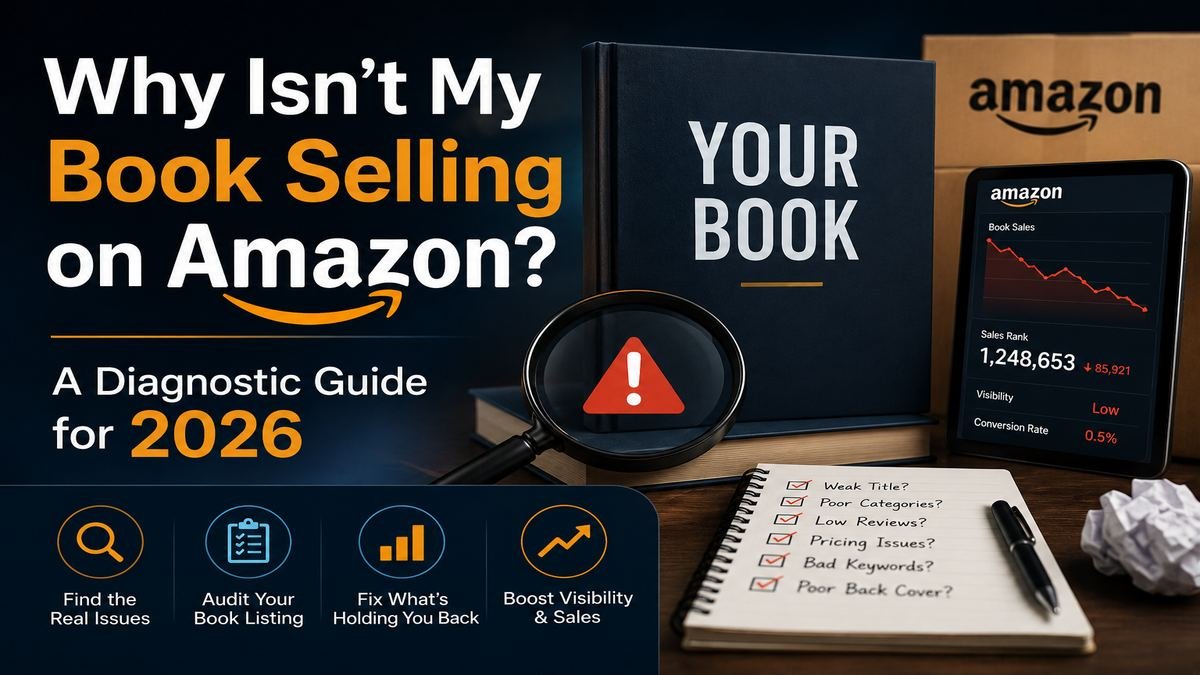
Your book is live, the cover looks good, and nothing is happening. Here is how to work out what is actually wrong before you spend money fixing the wrong thing.
| THE SHORT ANSWER Books fail to sell for one of two reasons, and they need completely different fixes. Either nobody is seeing your book — a visibility problem caused by weak keywords, wrong categories, or no advertising — or people are seeing it and not buying, which is a conversion problem caused by the cover, the description, the price, or a lack of reviews. Diagnose which one you have before changing anything. The fastest way to tell: if your book gets impressions in Amazon Ads but almost no clicks, it is the cover. If it gets clicks but no sales, it is the description, price or reviews. If it gets no impressions at all, it is keywords and categories. |
You spent months writing it. You paid for editing. You clicked publish, told your friends, and watched the sales dashboard.
Then a week went by. Then a month. The rank number climbed into six figures and stayed there.
Here is the part worth knowing: this is the normal outcome for a book that goes live without a discovery plan, and it is usually fixable. Amazon is a search engine that happens to sell books. A book nobody can find does not sell, no matter how good it is — and that is a solvable problem rather than a verdict on the writing.
First: which problem do you actually have?
Almost every author fixes the wrong thing first, usually by redesigning a cover that was never the issue. Diagnose before you spend.
| What You’re Seeing | The Problem | Where to Look |
| No impressions in ads; book never appears in search | Visibility | Keywords and categories |
| Impressions but very few clicks | Conversion — first impression | Cover, title, price shown in results |
| Clicks but no sales | Conversion — the product page | Description, reviews, Look Inside, price |
| Sales at launch, then nothing | Momentum | No ongoing traffic; ads and series strategy |
| Sales but poor reviews | Expectation mismatch | Cover and description promising the wrong book |
| Steady page reads, few purchases | Pricing | Test price points and KU positioning |
If you have no advertising running at all, you may not have enough data to diagnose anything. Running a small ad budget for two weeks purely to generate impressions and click data is often the cheapest diagnostic available, and it usually pays for itself in avoided mistakes.
The seven fixes, in the order worth doing them
FIX 1 — Rebuild your keywords
KDP gives you seven backend keyword fields. Most authors waste them on single words like “mystery” or “thriller”, which are hopelessly competitive and duplicate what your category already tells Amazon. Use phrases a reader would actually type — “small town southern mystery”, “veteran comes home novel”, “clean romance second chance”. Do not repeat words already in your title or subtitle; Amazon indexes those separately, so repeating them wastes a slot. Do not use other authors’ names or trademarked terms.
FIX 2 — Fix your categories
Categories are how browsing readers find you and how bestseller ranking is calculated. The instinct is to choose the biggest, most obvious category, which is exactly wrong — in a category with tens of thousands of titles you will never surface. A more specific category with genuine relevance gets you visible, gets you a rank badge, and that badge itself drives conversion. Choose the most specific categories that honestly describe the book.
FIX 3 — Test your cover at thumbnail size
Almost all book discovery happens at roughly the size of a postage stamp. Shrink your cover to thumbnail dimensions and look at it beside the current bestsellers in your category. Can you read the title? Does the genre read instantly? Does it look like it belongs there? Covers fail not because they are ugly but because they do not signal genre fast enough. If your book gets impressions and no clicks, this is your problem, and no amount of keyword work will fix it.
FIX 4 — Rewrite the description as sales copy
Your description is not a summary. It is an advertisement, and only the first two lines are visible before the “read more” fold on most devices — so those two lines carry most of the weight. Open with the hook, not with setup. Use short paragraphs, use the HTML formatting KDP supports for bold and headers, and end with a clear reason to buy now. A plot summary written in the voice of a book report is the most common conversion killer on Amazon.
FIX 5 — Get your first reviews honestly
Books convert dramatically better once they clear the psychological threshold of having a visible body of reviews. Build toward that through legitimate routes: an advance reader team, your email list, review-focused newsletters and communities, and simply asking readers at the end of the book. Never buy reviews or trade them — Amazon detects this reliably, and the consequences range from removed reviews to a terminated account. There is no version of this shortcut that is worth the risk.
FIX 6 — Test your price deliberately
On Kindle, the 70% royalty band applies between $2.99 and $9.99; outside it you earn 35%, which means a $10.99 ebook can earn less per sale than a $9.99 one. Within that band, price signals quality as much as it affects volume. A full-length novel at $0.99 can read as low-value to browsing readers. Test two or three price points for two weeks each and watch both units and total revenue — they do not always move together.
FIX 7 — Turn on modest, targeted advertising
Organic visibility on Amazon is driven substantially by sales velocity, which creates a circular problem: you need sales to get visible, and visibility to get sales. A small ad spend breaks that loop. Start with a low daily budget on tightly targeted keywords and comparable titles rather than broad category targeting. The goal at first is data and velocity, not immediate profitability.
| THE ORDER MATTERS MORE THAN PEOPLE THINK Advertising a book with a weak cover and a poor description simply pays to show more people something that does not convert. Fix discovery and conversion first, then spend. Authors who reverse this order routinely conclude that ads do not work, when what actually happened is that ads worked exactly as designed and revealed a listing problem. |
| Not sure which of these is holding your book back? Innovacia Publishers works with authors on Amazon optimization, cover design, description and keyword strategy, and full production — diagnosing what is actually wrong before recommending anything. Get a book listing review at innovaciapublishers.com |
What about AI and book discovery?
Something has changed in the last two years that most publishing advice has not caught up with: a meaningful number of readers now ask an AI assistant for book recommendations rather than browsing a category.
“Recommend a southern gothic suspense novel” or “what should I read after finishing X” are now common queries, and the books that come back are drawn from what those systems can find and understand about your title across the web — not solely from your Amazon listing.
The practical implication for authors is that discoverability now extends beyond Amazon itself. A book with an author website, a clear and consistent description everywhere it appears, a Goodreads presence, and coverage in places that discuss books is far easier for an assistant to surface confidently than one that exists only as a KDP listing.
This is early, and anybody claiming a reliable method to rank inside AI recommendations is overstating what is currently knowable. But the underlying work — a consistent author presence and clear, specific descriptions in more than one place — is worth doing on its own merits and positions you for it.
What does not work
- Buying reviews or joining review swaps — they get detected, removed, and can cost you your account. This is the fastest way to lose a book entirely.
- Stuffing keywords into your title — keyword stuffing your subtitle makes it read as spam to the exact readers you are trying to convert, and Amazon has become stricter about it.
- Choosing an unrelated category to grab a bestseller badge — a category you do not belong in produces a meaningless badge, poor conversion and eventual removal.
- Free promotion days as a whole strategy — a temporary rank spike without ongoing visibility work returns to baseline within days.
- Posting your book link in author groups — the audience there is other authors, not readers.
- Relying on social media alone — the same recycled announcement across every platform reaches almost nobody who was not already going to buy.
How long should this realistically take?
Set expectations properly, because most authors quit at exactly the point where the work starts paying.
| Timeframe | What to Expect | What to Do |
| Week 1–2 | Metadata changes indexed | Change keywords and categories; do not touch anything else |
| Week 3–6 | Early data on impressions and clicks | Diagnose visibility vs conversion; fix cover or description |
| Month 2–3 | Ads producing usable data | Refine targeting; cut what does not convert |
| Month 4–6 | Reviews accumulating, rank stabilising | Build toward the next title — a series is the strongest single lever |
| Month 6+ | Compounding, if the listing converts | Keep the backlist visible; a second book lifts the first |
The uncomfortable truth about self-publishing is that the single most effective way to sell more copies of your first book is usually to publish a second one. Series and backlist depth do more for author income than any individual optimisation — but only once the listing itself converts, which is why the fixes above come first.
Frequently asked questions
Why is my book not selling on Amazon?
Almost always one of two reasons. Either nobody is finding it — a visibility problem caused by weak backend keywords, poorly chosen categories, or no advertising — or people find it and do not buy, which is a conversion problem caused by the cover, description, price or absence of reviews. Diagnose which before changing anything: no impressions means visibility; impressions without clicks means the cover; clicks without sales means the product page.
How do I choose the right KDP keywords?
Use all seven backend keyword fields, and fill them with phrases a reader would actually type rather than single broad words like “thriller”. Avoid repeating words already in your title or subtitle, since Amazon indexes those separately and repeating them wastes a slot. Do not use other authors’ names or trademarked terms. Specific multi-word phrases describing setting, tone and premise outperform generic genre words.
How many categories can a book have on Amazon?
Amazon currently allows up to three categories per book, selected in your KDP dashboard. Choose the most specific categories that genuinely describe your book rather than the largest ones — a smaller category where you can realistically rank produces visibility and a bestseller badge, while a huge category buries you. Category rules change periodically, so confirm current limits in KDP before making changes.
Does the cover really matter that much?
Yes, and more than most authors expect, because nearly all discovery happens at thumbnail size. A cover that looks good at full size but is unreadable or genre-ambiguous as a thumbnail loses the click before anyone reads your description. The practical test is to shrink your cover to thumbnail dimensions and place it beside current bestsellers in your category — if it does not read instantly as the same genre, it is costing you sales.
What price should I set for my Kindle book?
The 70% royalty band on Kindle applies between $2.99 and $9.99; outside that range you earn 35%, so a higher price can produce lower earnings per sale. Within the band, price signals quality as well as affecting volume — a full-length novel priced at $0.99 can read as low value. Test two or three price points for around two weeks each and track both units sold and total revenue, since they do not always move in the same direction.
How long does it take for a self-published book to start selling?
Metadata changes are typically indexed within one to two weeks, meaningful data on advertising takes four to six weeks, and a listing that converts generally takes three to six months to build reviews and stable rank. Authors most often give up around month two, which is usually just before the work begins to compound. The strongest long-term lever is publishing a second book — but only once the first listing actually converts.
| You already wrote the book. That was the hard part. Innovacia Publishers helps authors with formatting and production, cover and interior design, Amazon keyword and description optimization, audiobook, and author websites — so a finished manuscript becomes a book readers can actually find. Talk to us at innovaciapublishers.com |